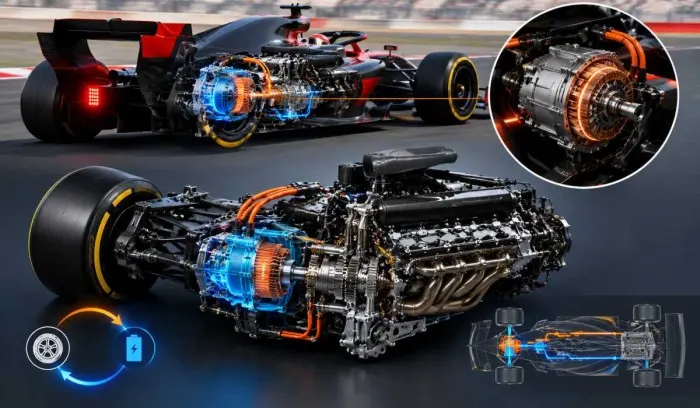
The MGU-K is the component of the Formula 1 car that transforms braking into electricity. Then it utilises that electricity to speed up the car. Consider it to be like a smart helper. It saves the energy that you may be discarding. It will return when you need it.
In 2026, this system became much more powerful and much more important. It is now a major part of how these cars perform. This Formula 1 MGU-K explained for beginners guide breaks it all down.
What Does MGU-K Stand For?
MGU-K stands for Motor Generator Unit – Kinetic. That is a fancy way of saying it is an electric motor that can also act as a generator. It connects directly to the engine's crankshaft .
It has two jobs. When the car brakes, it acts as a generator. It takes the car's forward motion and turns it into electricity. That electricity goes into the battery. When the car accelerates, it acts as a motor. It pulls electricity from the battery and sends power to the rear wheels .
So it does two opposite things depending on what the driver is doing. Brake, and it harvests. Accelerate, and it deploys.
Read More: F1 Rich List 2026: Drivers Ranked by Net Worth and Wealth
How Does MGU-K Work?
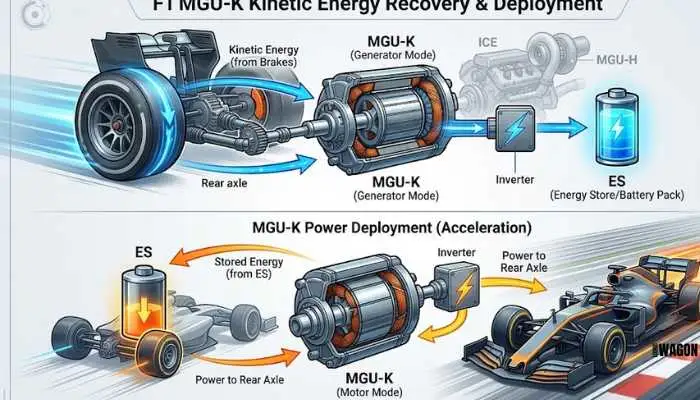
The basic idea is simple. But the details matter.
Under Braking
- When a driver hits the brakes, the car wants to keep moving forward. The MGU-K resists that motion. It creates drag on the rear axle. But instead of that energy becoming heat in the brake discs, the MGU-K turns it into electricity. That electricity charges the battery .
- This is why the rear brakes on an F1 car are smaller than the front. The MGU-K does some of the braking work for you .
Under Acceleration
When the driver gets back on the throttle, the MGU-K switches modes. It uses the stored electricity to spin the crankshaft faster. This adds power to the engine's output. The driver feels it as extra acceleration .
The 2026 Change: Super Clipping
Before 2026, the MGU-K could only harvest energy when the driver lifted off the throttle or braked. Now there is a new trick called super clipping.
On a full-throttle straight, the MGU-K can pull energy from the V6 engine itself. It uses the engine as a generator. This charges the battery even while the car is accelerating. The recovery rate is limited to 250 kW during super clipping, but it helps keep the battery topped up .
What Is MGU-H in Formula 1?
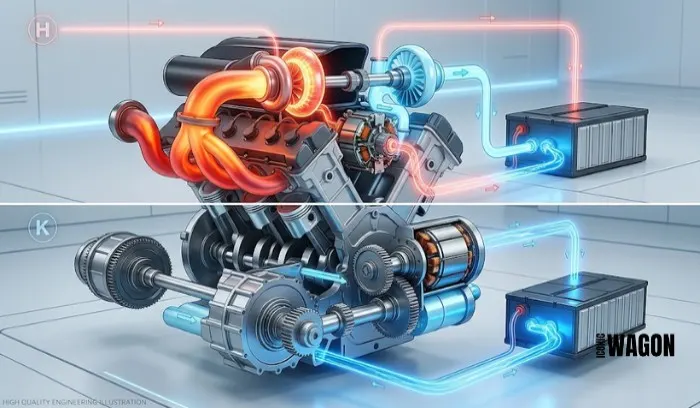
- MGU-H stands for Motor Generator Unit – Heat. It was the other hybrid part used in F1 from 2014 to 2025. It attached to the turbocharger and recovered energy from the hot exhaust gases .
- The MGU-H was very complex. It could spin the turbo to eliminate lag. It could also send energy to the battery without any limit. It was a huge performance differentiator. Teams that mastered it won championships .
- But it was also expensive. And it was complicated. So for 2026, the FIA removed it entirely. This was done to cut costs and make it easier for new manufacturers like Audi and Ford to join the sport .
The result? The MGU-K now does all the energy recovery work alone. The battery has to be charged through braking, coasting, and super clipping. There is no exhaust energy to help .
F1 MGU-K 2026: What Changed?
The 2026 rules made the MGU-K roughly three times more powerful. This is the biggest change to the hybrid system since it was introduced.
Power Increase
- The old MGU-K produced 120 kW (about 160 horsepower). The 2026 version produces 350 kW (about 475 horsepower) .
- That is a massive jump. The electrical power now makes up about 50% of the car's total output. The V6 engine produces around 400 kW. Combined, the power unit exceeds 1,000 horsepower .
Energy Limits
- More power does not mean unlimited energy. The battery is still small.
- The usable energy window is just 4 MJ (megajoules). That is the gap between the fullest and emptiest the battery can be during a lap . At full 350 kW output, that 4 MJ is gone in about 11.4 seconds .
The rules also cap recovery and deployment per lap. In race conditions, the limits are 8.5 MJ recovered and 8.5 MJ deployed . But the FIA adjusted these for 2026. In qualifying, the maximum recharge was reduced from 8 MJ to 7 MJ to reduce excessive harvesting .
Speed Taper
- The MGU-K does not give full power at all speeds. Full 350 kW is available up to 280 km/h. After that, deployment fades. By 340 km/h, normal MGU-K deployment drops to zero. The car relies only on the engine at top speed .
- This is to stop the battery from draining too early on long straights.
Overtake Mode
There is a special override for overtaking. It lets the chasing car hold full 350 kW up to 337 km/h. That gives a clear speed advantage over the car in front, whose electrical power is already fading .
You May Also Read: Max Verstappen Driving Style Explained: Secrets Behind Success
Why It Matters for Beginners?
The MGU-K explains a lot of what you see on track. When a car suddenly slows on a straight, it might be deploying too much energy too early. When a driver makes a late pass, they might have saved battery for the right moment. When a car is fast in qualifying but slow in the race, the energy management might be the reason.
In 2026, the MGU-K is not a small boost anymore. It is half the car's power. Drivers and engineers have to manage it carefully. The fastest car is not always the one with the most power. It is the one that uses its 4 MJ at the right places and gets enough back before the next big demand .
FAQs
1. What does MGU-K stand for?
Motor Generator Unit – Kinetic. It is the electric motor that recovers energy under braking and deploys it under acceleration .
2. How does the MGU-K work?
It acts as a generator when braking, turning motion into electricity. It acts as a motor when accelerating, using stored electricity to add power to the rear wheels .
3. What is MGU-H in Formula 1?
Motor Generator Unit – Heat. It recovered energy from the turbocharger's exhaust gases. It was removed for 2026 to cut costs and complexity .
4. How much power does the 2026 MGU-K make?
350 kW, which is about 475 horsepower. That is nearly three times the old 120 kW limit .
5. Why did F1 remove the MGU-H?
To reduce costs and make it easier for new manufacturers to enter the sport. The MGU-H was expensive and complex .
6. How long can the MGU-K deploy full power?
At 350 kW, the 4 MJ battery window is gone in about 11.4 seconds. After that, the car relies more on the engine .
7. What is super clipping?
It is a 2026 feature that lets the MGU-K harvest energy from the engine while the car is at full throttle. It charges the battery even on a straight .
8. What is the difference between MGU-K and KERS?
KERS was the older system, introduced in 2009. It was simpler and less powerful. The MGU-K is the evolved version that came with the 2014 hybrid rules and became much more powerful in 2026 .